⭐100K+ Monthly Downloads
⭐Top 20 Apple Management
⭐100K+ Monthly Downloads ⭐Top 20 Apple Management

The Small
Business
Cyber Security Guy
Welcome to the blog and podcast, where we share brutally honest views, sharp opinions, and lived experience from four decades in the technology trenches. Whether you're here to read or tune in, expect no corporate fluff and no pulled punches.
Everything here is personal. These are my and the team’s thoughts, opinions forged in the heat of battle! And not those of our employers, clients, or any other professional with whom we are associated.
If you’re offended, take it up with us, not them.
What you’ll get here (and on the podcast):
Straight-talking advice for small businesses that want to stay secure
Honest takes on cybersecurity trends, IT malpractice, and vendor nonsense
The occasional rant — and yes, the occasional expletive
War stories from the frontlines (names changed to protect the spectacularly guilty)
I've been doing this for over 40 years. I’ve seen genius, idiocy, and everything in between. Some of it makes headlines, and most of it should.
This blog and the podcast are where we break it all down.
Grab a coffee and pull up a chair, you need to see this!
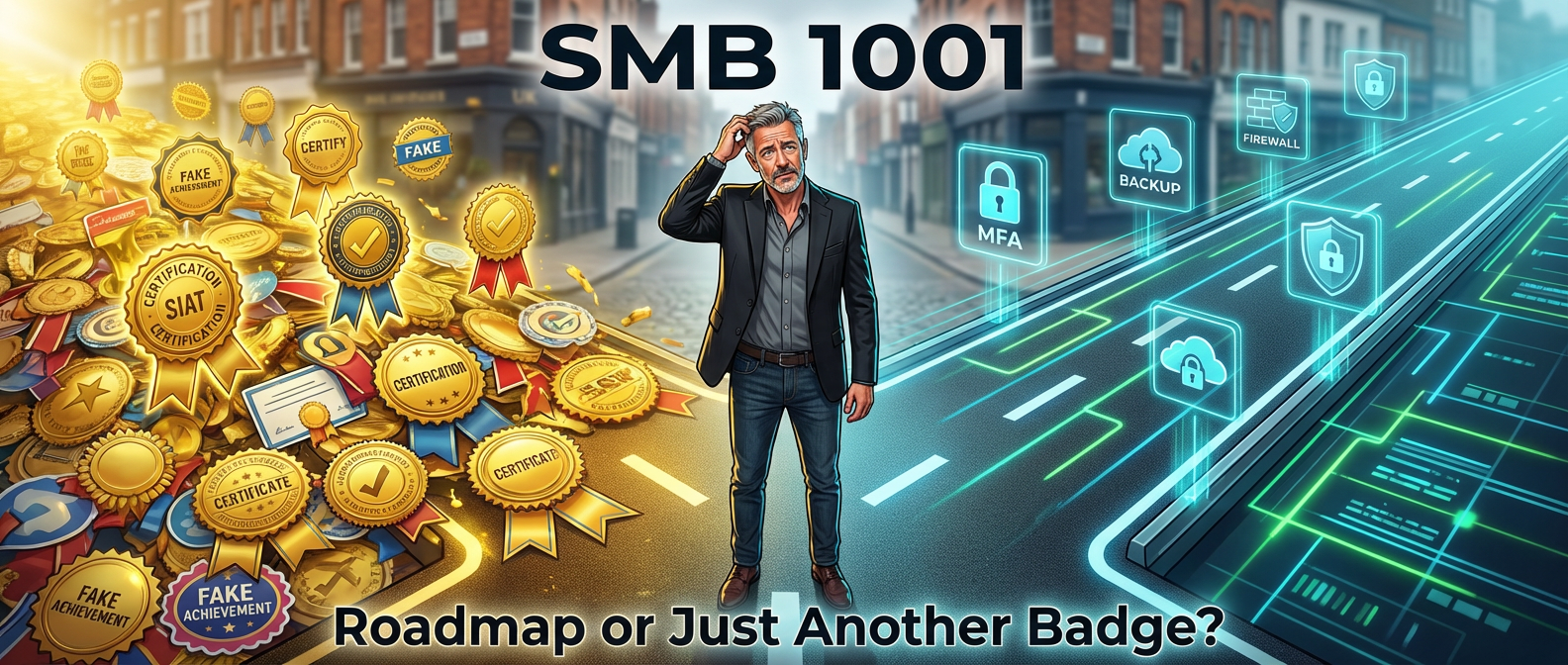



The Certificate That Made Things Worse: A Cyber Essentials Scope Drift Case Study
By the time anyone at Meridian Advisory noticed the problem, their Cyber Essentials certificate had been renewed four times.
Each renewal had covered the same carefully defined scope: two office servers, the on-premises file share, and about fifteen managed laptops.
By 2025, the actual business ran on Microsoft 365, a cloud-based CRM, a remote project management platform, and a VOIP system. None of those were in scope.
When a credential-based breach exposed client financial data held in the CRM, the certificate did not protect them. It gave the ICO a very interesting set of questions to start with.

The Bank of England Just Told You Your Financial Sector Can't Do Basic Cybersecurity. Again.
The Bank of England runs live cyberattack simulations on the UK's most critical financial institutions every year. Real attacks, on live systems, designed by intelligence analysts who know exactly how sophisticated threat actors operate.
The 2025 results are in. Weak passwords. Overly permissive access controls. Systems that haven't been patched. Staff who hand over credentials when asked convincingly. Third year running. Same findings. If the institutions that hold your money, process your payroll, and underwrite your insurance can't manage basic cyber hygiene under direct regulatory pressure, you need to ask a harder question: what does your accountant's network look like?

What Happened to the 14 Million People the Currys’ Breach Left Behind
Darren Warren asked for five thousand pounds for the distress of having his data stolen from Currys' tills. The High Court struck most of his claim out.
Meanwhile, specialist law firms ran "Were you affected by the Currys breach?" campaigns, then quietly closed their books without any settlement.
The Court of Appeal confirmed in February 2026 that DSG absolutely had a duty to protect that data. By then, most claimants' limitation periods had expired.
This is the story of how 14 million people ended up with nothing, and the practical lesson every small business owner needs to take from it.

The ICO Called It a "Significant Victory". Try Telling That to 14 Million People Who Got Nothing.
The ICO's General Counsel called the Currys Court of Appeal ruling "a significant victory." And in strict legal terms, she is right.
Lord Justice Warby's judgment closes a dangerous loophole and clarifies that personal data must be assessed from the controller's perspective. But while the lawyers celebrate, roughly 14 million people are sitting with expired limitation periods and no compensation route.
The legal system confirmed DSG was in the wrong at the precise moment most victims could no longer act on it. I'm Mauven MacLeod, and this is what that really tells us about who UK data law serves in practice.

Three and a Half Pence Per Victim: The Currys’ Breach, Nine Years of Legal Theatre, and What Your Business Must Learn
Darren Warren asked for five thousand pounds in compensation for the distress of having his data stolen from Currys' tills. The High Court struck most of his claim out. Meanwhile, specialist law firms ran "Were you affected by the Currys breach?" campaigns, then quietly closed their books without any settlement.
The Court of Appeal confirmed in February 2026 that DSG absolutely had a duty to protect that data. By then, most claimants' limitation periods had expired.
This is a case study in how 14 million victims ended up with nothing, and what it means for every business owner who thinks "the system will sort it out."
Europe Is Leaving. The UK Is Sleepwalking. And Nobody in Charge Seems Bothered.
France banned Zoom and Teams from government. Germany is migrating 30,000 workstations to open source and saving €15 million a year. The Dutch Parliament demanded exit strategies from US cloud. Switzerland declared US cloud unsuitable for government data.
The UK has produced no sovereign cloud strategy, no government migration programme, no regulatory enforcement on CLOUD Act exposure, and no explicit guidance for commercial organisations.
Noel Bradford, with 40-odd years of watching the UK IT establishment make the same mistakes on repeat, asks the question nobody in Whitehall wants to answer: when did we decide that digital independence was somebody else's problem?

Switzerland Said No. The UK Said Hold My Beer. The Palantir Case Study Every Business Owner Needs to Read.
Switzerland's military commissioned a 20-page risk assessment of Palantir's software. The findings were blunt: data held by Palantir could be accessed by the American government, leaks could not be technically prevented, and the Army would become dependent on Palantir specialists. The recommendation was unambiguous: consider alternatives. Neutral Switzerland quietly walked away.
The United Kingdom looked at the same company and gave them more than £900 million in contracts across the NHS, Ministry of Defence, policing, nuclear weapons support, and border planning. Same company. Same risks. Opposite conclusions. This is the case study every UK business owner needs to read.

Fortinet's Security Crisis: Why Does Nobody Care That Your VPN Is a Nation-State Playground?
Here's a question that should keep every director awake: what happens when the device meant to protect your network becomes the primary way attackers get in?
Between 2023 and now, Fortinet's SSL VPN has been exploited three separate times using the same type of vulnerability. Chinese intelligence services stole configurations from 20,000 organizations worldwide.
Cyber insurers charge double the premiums for businesses using Fortinet kit. Yet Fortinet posted 50% revenue growth and continues to dominate the enterprise firewall market.
This isn't a technical problem. It's a market failure that puts your business at risk while nobody gives a damn.

The Psychology of Cybersecurity Negligence: Why Smart People Make Fatal Decisions
Nobody wakes up and decides to let patients die through cybersecurity negligence. Yet that is precisely what happened at Synnovis. The executives who failed to enable multi-factor authentication were not cartoon villains.
They were educated professionals running a critical healthcare organisation. So why did they make a decision that, in hindsight, seems obviously catastrophic?
The answer lies in the psychological mechanisms that allow intelligent people to rationalise terrible choices, the organisational structures that insulate decision-makers from consequences, and the systemic failure to connect cybersecurity decisions to real-world harm.
Understanding this psychology is essential to preventing the next preventable death.

When Your Biggest Customer Gets Hacked: The £1.9 Billion Lesson No One’s Talking About
Financial Accountant magazine just published my analysis of the £1.9 billion Jaguar Land Rover cyberattack. But here’s what the article couldn’t cover: the small suppliers who died from JLR’s breach. You didn’t get hacked. Your biggest customer did. You still lost everything.
One supplier laid off 40 people because JLR couldn’t place orders for six weeks. Proper security. Good practices. Still went bust. After 40 years in the IT world Intel, Disney, and the BBC, I’ve seen this pattern before. Enterprise companies have bailouts and cash reserves.
Small suppliers have three weeks of runway. Your cybersecurity doesn’t matter if your customer’s fails.

The Nottingham Agency That Spent £47,000 on Cloud Bills They Didn't Need
Twenty-three employees. Eighteen months. Forty-seven thousand pounds wasted on cloud infrastructure they didn't need, SaaS subscriptions nobody used, and auto-scaling rules designed by a consultant who'd never checked back. This isn't a horror story about a massive enterprise with unlimited budget.
This is CloudBridge Digital, a Nottingham digital agency that discovered they'd been hemorrhaging cash while Microsoft, AWS, and a parade of SaaS vendors quietly helped themselves to the company bank account.
Here's what went wrong, how they discovered it, and the six-month recovery plan that clawed back £32,000 of annual waste.

Another UK SME Wastes £20k on 'Comprehensive CyberSec': Still Gets Breached
Security vendors are playing you for fools, and they're getting rich doing it. Every week I watch UK business owners waste £20,000 on "comprehensive cybersecurity platforms" when they needed £5,000 of basic IT security.
The industry deliberately muddies the difference between InfoSec, CyberSec, and IT Security because confused customers pay premium prices for inappropriate solutions. Meanwhile, 50% of small businesses were breached in 2025, proving that expensive confusion doesn't equal protection.
Time to understand what these terms actually mean, what they really cost, and which approach keeps your business alive instead of just enriching consultants.
Stop getting fleeced.

When Insider Threats Strike: Real-World Case Studies and Business Lessons
A teenager extorted 2.85 million dollars from PowerSchool. A student in Iowa ran a grade change business with pocket keyloggers. UK schools lost days of teaching to ransomware. None of this needed elite tools. It needed access, weak controls, and time. That is your wake up call. Do you know what your vendors hold about you? Do you keep more data than you need? Could someone walk up and plug in a device? Layer simple controls. Use MFA. Limit access. Monitor for odd activity. Test restores. Plan for vendor failure. Will you act before your data funds someone else’s payday?

Confessions of a Reformed School Hacker: How Getting Caught Changed My Career
Curiosity, access, and a careless password shaped my career. At sixteen I learned the simplest attack works best. I watched a teacher type admin123! and saw the whole network open up. No exploits. Just human nature. That is the insider threat in plain sight. People bypass clumsy controls to get work done. Do your policies help or hinder? Make secure the easy path with least privilege, SSO, MFA, logging, and coaching. Treat incidents as data, not drama. Channel curiosity before it goes underground. Would your systems survive a bright teenager with time after school? If not, what will you change this week?

Why Good Employees Make Bad Security Decisions: The Psychology Behind Insider Threats
Security fails when it fights how people work. Most breaches are not villains. They are good staff blocked by bad design. The ICO shows students guessed weak passwords or read them off notes. The lesson is simple. If the secure path is slow, people route around it. Make secure the easy choice. Use single sign on. Use MFA that is one tap. Give safe tools for sharing files. Build trust so people report mistakes. Review real behaviour, not policy fantasy. Do your controls help work or hinder it? If a pupil could beat them before lunch, what would your team do?

Your Biggest Cyber Threat Wears a School Uniform: What Small Businesses Can Learn From School Hackers
Insider threats are not shadowy hackers. They are people already inside your walls. The ICO found students caused most school data breaches by guessing weak passwords or reading them off sticky notes. They were not breaking in. They were logging in. Sound familiar? If a teenager can bypass controls, what would a bored employee try next? Audit access today. Turn on multi factor authentication. Stop forcing impossible passwords people write down. Log activity on sensitive systems. Train for curiosity, not fear. Can your security survive a Year Eleven with time to spare? If not, you need to fix it now.

When Criminals Target Children: The Kido Nursery Attack and What It Means for UK Small Businesses
After yesterday's Kido International ransomware attack, I've spent the night reading through the technical details and regulatory implications. What I'm seeing isn't just disturbing. It's a fundamental shift in how we need to think about protecting sensitive data in British small businesses.
Yesterday morning, 18 UK nursery locations woke up to a ransomware attack. The attackers didn't just encrypt systems. They stole the entire database. Names of 8,000 children. Home addresses. Photos. Safeguarding notes.
Then they did something I've never seen in four decades of IT: They published profiles and photographs of ten children on their darknet leak site.

The DORA Reckoning: How September's Cyberattacks Just Triggered Europe's First Cross-Border Regulatory Crisis
September 2025's Collins Aerospace and JLR cyberattacks weren't just operational disasters - they triggered Europe's first cross-border regulatory crisis under DORA. While aviation experts focused on flight delays, they missed the real story: EU authorities now have direct oversight powers over US companies like Collins Aerospace serving European financial infrastructure. DORA's January 2025 implementation created unprecedented cross-border enforcement mechanisms that most businesses don't understand. Collins faces potential Critical Provider designation, direct EU regulation, and millions in fines. Meanwhile, UK businesses remain spectacularly unprepared for a regulatory framework that can penalize their technology dependencies. The DORA reckoning has begun.

It’s Cheaper to Be Defensive: Why Waiting for a Breach Is the Most Expensive Mistake You’ll Ever Make
Three out of four UK businesses admit they’d break the law to pay a ransomware gang, proving they’re not prepared — they’re desperate.
This hard-hitting article exposes the brutal truth behind the PR Newswire findings and dismantles the myth that cybersecurity is too expensive. It’s not. What’s expensive is losing your business, your data, and your reputation.
We break down why defensive investment is always cheaper than recovery, what leaders are doing wrong, and how to fix it before disaster strikes.
If you're gambling on hope instead of hard controls, this is your wake-up call. Prevention isn’t optional. It’s survival.

The Online Safety Act: Digital Dictatorship Disguised as Child Protection
The UK Online Safety Act has been live for 48 hours and it's already the most spectacular digital disaster since Internet Explorer. VPN usage surged 1,400%, teenagers are using Death Stranding screenshots to bypass age verification, and Ofcom is reduced to sending strongly worded letters to companies that ignore them entirely.
We've created a surveillance regime that doesn't protect children, doesn't stop harmful content, and can be defeated by PlayStation screenshots. This isn't child protection - it's digital authoritarianism disguised as safety theatre. Pull up a chair to the circumvention party.
⚠️ Full Disclaimer
This is my personal blog. The views, opinions, and content shared here are mine and any contributors and ours alone. They do not reflect or represent the views, beliefs, or policies of:
Our Day Job employers
Any current or past clients, suppliers, or partners
Any other organisation We affiliated with in any capacity
Nothing here should be taken as formal advice — legal, technical, financial, or otherwise. If you’re making decisions for your business, always seek professional advice tailored to your situation.
Where we mention products, services, or companies, that’s based purely on our own experiences and opinions — We are not being paid to promote anything. If that ever changes, we’ll make it clear.
In short: This is my personal space to share my personal views. No one else is responsible for what’s written here — so if you have a problem with something, take it up with me, not my employer.